March 3, 2026
At first glance, the northern Yucatán Peninsula seems almost too simple. It’s flat. No mountains. No valleys. The land barely rises more than 30 meters above sea level.
But beneath that quiet surface lies one of the most extraordinary underground worlds on Earth.
The ground here is made mostly of limestone — soft, pale rock formed millions of years ago from the compacted skeletons of ancient marine organisms. What we see today above sea level is only a small exposed portion of a massive carbonate platform that grew slowly on the ocean floor.
The peninsula was born underwater.
Around 20,000 years ago, during the last Ice Age, sea levels were about 120 meters lower than today. Many of the cenotes we now swim and dive in were once completely dry caves.
As glaciers melted and oceans rose, water flooded back into these underground chambers. Over hundreds of thousands of years, sea levels rose and fell repeatedly. Each shift moved the underground water table up or down, reshaping the caves from the inside out.
The Yucatán did not simply “emerge” from the sea once — it has been submerged and exposed again and again.

The process begins with rain.
As rainwater passes through jungle soil, it absorbs carbon dioxide and becomes slightly acidic. When this water reaches limestone, it slowly dissolves the rock. Over immense spans of time, tiny cracks widen into tunnels. Tunnels expand into chambers.
In coastal areas, something even more powerful happens. Fresh groundwater floats above heavier saltwater, forming a mixing zone called a halocline. This boundary is especially corrosive, dissolving rock more aggressively and carving wide horizontal passages — many of which divers explore today.
The caves are still evolving.
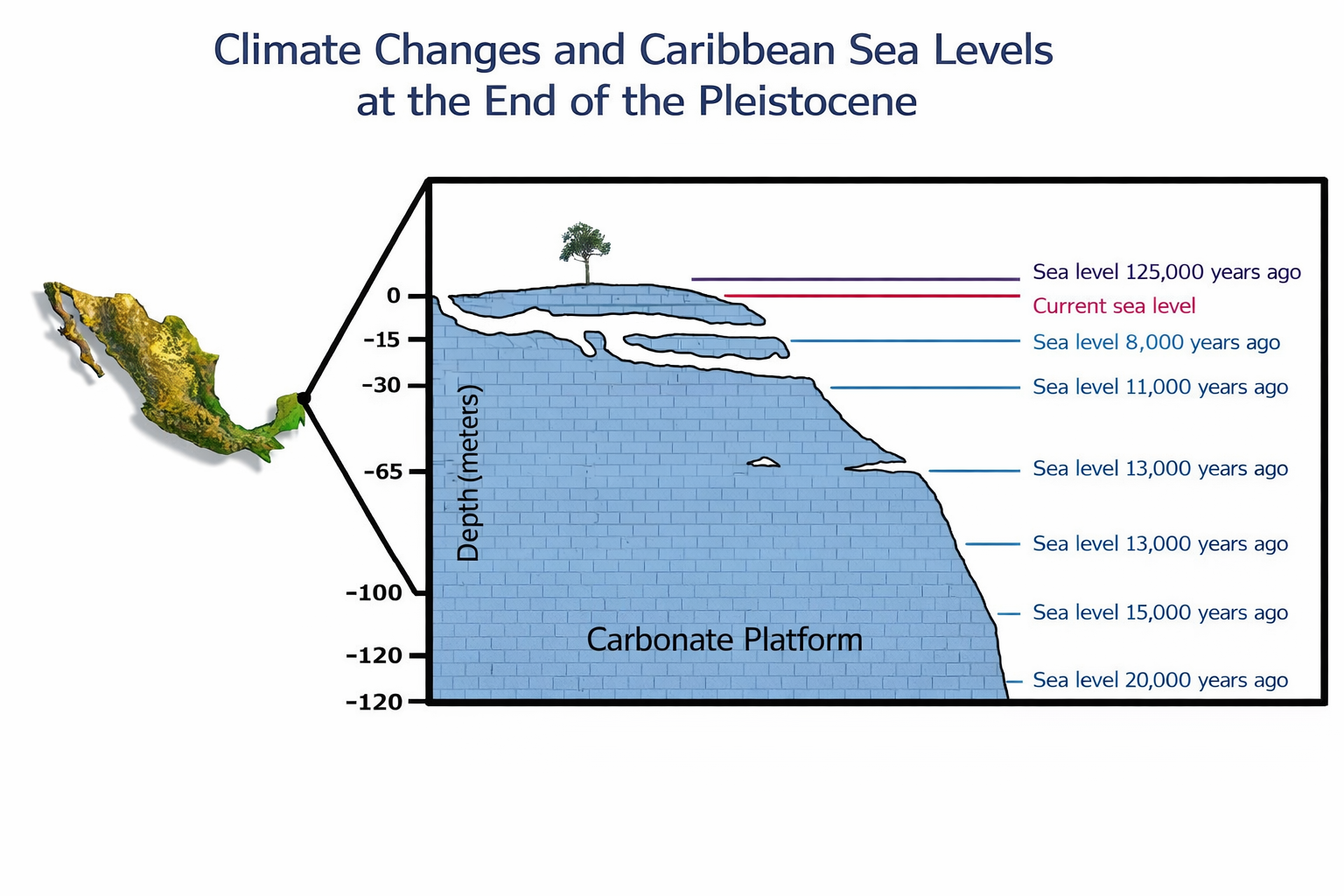
During glacial periods, when sea levels dropped, the underground water level fell too. Flooded caves became air-filled. Without water supporting their ceilings, some sections collapsed.
When part of the roof gives way, a cenote is born — a natural window into the underground world.
Some cenotes are wide and open to the sky. Others are deep vertical shafts. Along the coast of Quintana Roo, many formed from long-term dissolution and collapse. In the central peninsula, deeper “pit cenotes” may have formed from upward-moving water dissolving rock from below.
Each shape tells a different geological story.
Cenotes are not isolated pools. They are openings into a vast, interconnected groundwater system — the peninsula’s only reliable source of freshwater.
Because limestone is so porous, rivers rarely exist on the surface. Rain disappears quickly underground. For the ancient Maya, cenotes — called ts’ono’ot, meaning “water deposit” — were sacred and essential for survival.
Today, although many are known for tourism, their importance is far greater. These systems record climate history, preserve archaeological evidence, and sustain modern communities.
They are beautiful — but they are also fragile.
Exploration teams have mapped hundreds of kilometers of underwater cave systems in Quintana Roo. Some are among the longest submerged caves in the world. Yet much of the system remains unknown.
To enter a cenote is to enter deep time — a space shaped by marine life millions of years ago, carved by acidic rainwater, expanded by shifting seas, and opened by collapse.
What looks like a simple pool of blue water is actually the visible edge of a vast and ancient world beneath our feet.